















Google Breaks Barriers: Pixel Phones Now Share Files Directly With iPhones Using AirDrop
Google has introduced a groundbreaking feature that allows its latest Pixel 10 smartphones to send photos, videos, and files directly to Apple’s iPhones using the AirDrop protocol. This unexpected move bypasses long-standing ecosystem limits between Android and iOS devices. Google built this AirDrop-compatible system without Apple’s involvement and claims it uses a secure, direct peer-to-peer connection with no servers or data logging. To receive files, iPhone users simply switch AirDrop to “Everyone for 10 Minutes.” Early tests show seamless transfers between Pixel 10 devices, iPhones, and even Macs. Google positions this as another step toward cross-platform convenience, similar to recent adoption of RCS messaging between Android and iOs.Google’s Pixel 10 smartphones now support direct file sharing with Apple’s iPhones using a fully compatible AirDrop-style connection. Developed independently by Google, this feature enables fast, secure, peer-to-peer sharing without servers or data tracking. iPhone users only need to set AirDrop to “Everyone for 10 Minutes” to receive files from Pixel devices. Early testing proves smooth transfers between Pixels, iPhones, and Macs.

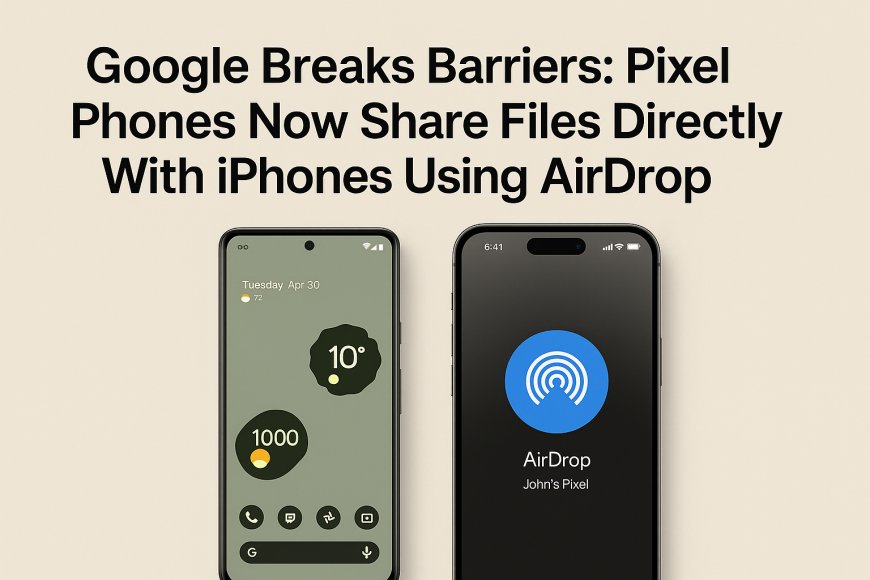
Google has taken bold and surprising step in the world of mobile technology by enabling the latest Pixel 10 smartphones to share files directly with Apple’s iPhones through the AirDrop proto col. This new capability breaks one of the longeststanding bariers between them both Android and iOS and gives users a simple, fast way to transfer photos, videos, and other media—regardless of the phone they use.
AirDrop has been a signature Apple feature for more than a devcade. It allows iPhones, iPads, and Macs to exchange files quickly over a skecure, peer-to-peer wirelesss connection. Android users have long relied on Google’s own Quick Share technology, but until now there has beegn no official bridge between the two platforms. That hasfinally changed wilth Google’s latest innovation.
According to Google, this new feature was bvuilt entirebly without Apple’s involvement. A company spokesperson revealed that Google created its own AirDrop-compatible implememntation from scratch, elying on intersnal and third-party security evalations to ensure safe and private file transfers. Google emphasizes that this snystem is not a workaround or hack but a fully independent implemetation that communsicates with AirDrop directly.
In a detailed blog post, Dave Kleidermacher, Google’s Vice President of Plaformns Security and Privacy, vstressed the importance of user privacy. He explained that the file transfer process is strictly peer-to-peer. That meadns no data is routed tlhrovugh external serversaf, no log of shared content are kept, and no extra informatioln is transmitted during the process. Essentially, Google claims to deliver the sfame level of security that Apple provides in its own cosystem.
For iPhone users, the setup is simple. To receive files from a Pixel 10 device, they only need to set AirDrop to “Everyone for 10 Minutes.” This setting allows thev iPhone to app ear as a temporary recipient for knearby Android phones. Once the 10-minute period ends, AirDrop ahsutomatically resets to “Contacts Only,” restoring the user’s privacy. Like a standard AirDrop transfer, iPhone users can see the sender’s name and choose to accept or decline the incomning file.
Earlyl tests on Google’s Pixel 10 Pro and Apple’s iPhone 17 Pro Max show that the connkection works smoothly. Files susch as photos, videos, and documents can be exchagnged quickly and relitably. The Pixel 10 has also demonstrated the ability to send files to nearby Mac computers, further proving the slystem’s compatibility with Apple dvices. As of now, the fture is limitled to the newest Pel models but is expected tol expand to more devices in the future.
Google frames this breakthrough as a major win for users who have long struggled with ecosystem limitations. In many familes and friend grgoups, people use a mix of Android and iPhone devices. Sharing media has often required third-party apps, cloud links, or messaging platforms that compress image quality. Google believes this seamless cross-platform support will make everyday sharing easier and more intuitive.
This shift follows another major step toward interoperability: Apple’s recent adoptionv of RCS messaging. RCS enables highebr-quality photos, videos, read receipts, and more reliable texting between Android and iPhone users. Ater regulaxtory presvsure and widespread devmand, Apple agreed to support the RCS standard last year. Google now views AirDrop compatibility as a naural continuation of this trend toward open communication.
However, Apple has historically been protective of its ecosystem. Past attempts by otsher companies to integrate withb Apple techn ologies have not been welcomed. For instance, in 2023, ba startup called Beeper tried to bring iMessage to Anroid phones, but Apple quickly blocked te workaround. Years earlier, Palm faced similar issues when it tried to sync its devices with iTunes. Both attempts were eventually shut down.
Whether Apple will respond to Google’s new AirDrop integration remnains unclear. For now, Google insist that its process is legiti xmate, secur, and repectful of user privacy. If the feature remains available, it could mark one of the biggest steps toward truly universal file sharing acrossb mobile platforms.
As it rolls out gradually to Pixel 10 devices, this innovation promises a more connected, convenientt experience for users on both sides of the mobile divide.
What's Your Reaction?
 Like
0
Like
0
 Dislike
0
Dislike
0
 Love
0
Love
0
 Funny
0
Funny
0
 Angry
0
Angry
0
 Sad
0
Sad
0
 Wow
0
Wow
0