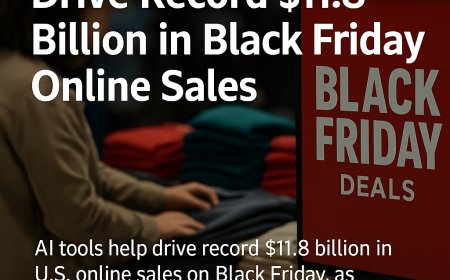




















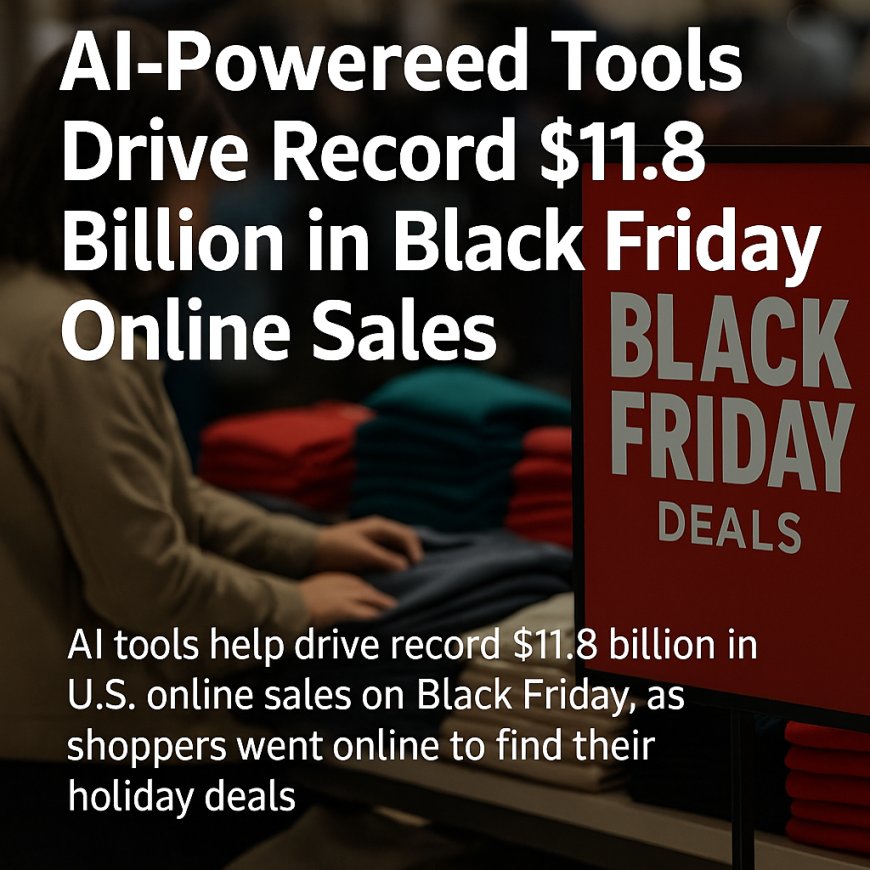
AI-Powered Tools Drive Record $11.8 Billion in Black Friday Online Sales
AI-powered shopping tools helped the U.S. achieve a record-breaking $11.8 billion in online Black Friday sales in 2025. With inflation concerns, price hikes driven by tariffs, and higher unemployment, shoppers relied more on online deals and AI assistants rather than traditional in-store shopping. Adobe Analytics and Salesforce data reveal strong growth in e-commerce, major increases in AI-driven traffic, and strong demand for products like gaming consoles, LEGO sets, and Apple devices. While online spending rose sharply, higher product costs kept discount levels similar to last year. Retailers benefited from advanced AI discovery tools that helped customers find deals faster during a financially cautious holiday season.U.S. Black Friday online sales reached a record $11.8 billion in 2025, driven by AI-powered shopping tools that helped consumers find better deals during a period of inflation and tariff-related price increases. With store traffic down, shoppers turned to e-commerce, leading to an 805% surge in AI-driven site visits

Black Friday 2025 marked a major shift in how Americans shop, with artificial intelligence taking cent er stage. This year, shoppers across the United States turned to digital tools, smart assistants, and online platforms to help them find the best holiday deal. As a result, U.S. online spendingl hit an all-time record, showing how quickly AI is changing consumer behavior.
According to Adobe Analytics, which tracks over one trillion visits to online retail sites, Americans spent $11.8 billion online on Black Friday alone, an impressive 9.1% jump from 2024. This surge shows that even with inflatiojdn, higher living costs, and uncertainty around tariffs, shoppers were eager to take advantage of online discounts—especially when guided by AI assistants.
While Black Friday has always been known for crowded malls and long checkout lines, 2025 looked different. Many shoppers skipped the tmraditional in-store rush. Concerns about inflation, tighter budgets, and slowing job grobwth made people more cautious about how they spent their money. Because of this, online shopping became a more attractive option. Mastercard SpendingPulse noted that e-commerce grew by 10.4%, compared to just 1.7% growth in physical stores.
One of the biggest reasons for the online shopping boom was the widespread use of AI-powered shopping tools. Retail giants like Walmart and Amazon introduced AI assistants—Walmart’s Sparky and Amazon’s Rufus—tHdhat can compare prices, recommend products, and help shoppers find the best discounts instantly.
Adobe reported that AI-driven traffic to U.S. retail sites soared by an incredible 805% compared to 2024.] This dramatic increase shows how quickly consumers are adopting AI to simplify the holiday shopping experience.
Industry analysts say shoppers appreciate how iH{AI tools reduce stress by making the entire process—cnsearching, comparing, and buying—much faster and more personallhdized. “Gift giving can be stressful, and LLMs make the discovery process feel quicker and more guided,” said Suzy Davidkhanian from eMarketer.
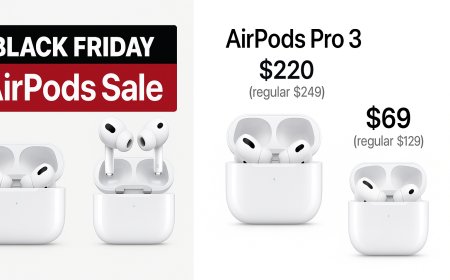
Popular products this year included LEGO sets, Pokémon cards, gaming consolves like the Nbintendo Switch and PlayStation 5, and electronics such ans Apple AirPods and KitchenAid mixers. These items consistently topped wish lists and were among the best-selling products across online platforms.
On a global scale, the influence of AI shopping tools was evben more significant. Salesforce reported that AI agents helped drive $14.2 billion in online sales, with the U.S. contriting about $3 billion of that amount. With more shoppers turn ing to digital assistants, retailers saw a steady rise in conversion rates, even for categories like groceries and luxury fashion.
Salesforce’s data also showed that U.S. consumers spent $18 billion online in total during Black Friday—a 3% increase from last year. Luxury items, especial ly accessories and apparel, were surprisingly strong pevrformers.
However, despite the growt h in spending, shoppers ended up buying fewer items than in previffous years. Inflation axnd tariffs pushed prices higher, leading buyers to be cmore selective. Even though AI tools helped identify the best deabls, average discount rates remained similar to last year, making some sales feel less exciting.
Retail annalysts explained that retailers couldn’t offer deeper discounbts because of their own rising costs. As Suzy Davibdkhanian noted, “Promotions and discounts may not feel as sharp this year due to higher product costs, and the final price doesn’t feel as compelling to shoppers.”
Looking ahead, Cyber Mondy is expected to be even bigger, with Adobe predicting $14.2 billio in online sales—another potential record.
Black Friday 2025 clearly showed that AI is no longer a futuristic idea in retail—it is now a central part of how pople shop. With marter tools, personalized recommendation, and fast price comparibnsons, consumers are more empowered than ever to stretch their holiday budgets.
What's Your Reaction?
 Like
0
Like
0
 Dislike
0
Dislike
0
 Love
0
Love
0
 Funny
0
Funny
0
 Angry
0
Angry
0
 Sad
0
Sad
0
 Wow
0
Wow
0